
Sussex County Projected Release Dates
A projected date is a calculation based on information known at the time. It may reflect the sentence, jail credit, earned-credit class, and other events in the record. It does not prove that a person has passed through the release process. An actual date comes from the booking/release entry, VADOC's Notification of Release, or other dated documents signed and processed at release.
The distinction is sharp in Sussex County. A person awaiting trial may have a bond order but no fixed exit date. Bond terms may remain unmet, processing may continue, or another warrant may impose a hold. A sentenced person at Sussex I State Prison has a state calculation. A person serving a local term requires the Sheriff's or actual jailer's computation rather than the state-prison formula. Someone who left the closed Sussex II campus during its shutdown was normally transferred, not released.
- Projected release date
- A future date calculated from the current sentence and credit record.
- Actual release date
- The date custody ended or shifted as recorded by the responsible agency.
- Detainer
- A request or legal basis for another authority to take custody when the current term ends.
- Jail credit
- Qualifying time already spent in confinement that is counted toward a sentence.
Find a Sussex County Release Date
Choose the channel by custodian. For a state prisoner, use the VADOC Inmate and Supervisee Locator. It accepts either a seven-digit DOC ID or a full last name with at least the first three letters of the first name. Location, race, gender, and age range are optional filters. The page requires acceptance of its disclaimer and reCAPTCHA. VADOC says the data is updated daily while warning that accuracy and currency cannot be guaranteed.
For a local Sussex booking or sentence, call the Sussex County Sheriff at 434-246-5000. Ask where the person was booked, which agency now holds the record, and whether a release date exists. The county site does not publish a roster, sentence calculator, or release-date view. A court order can explain the sentence or bond decision, but the jailer's entry supplies the physical release event.
- Identify whether the person is pretrial, locally sentenced, in VADOC custody, under supervision, or held by another authority.
- For VADOC, search by DOC ID when possible and match the biographical fields before recording the locator's “Release Date.”
- For local custody, ask the Sheriff for the actual custodian and request the release entry or releasable computation record.
- Check the Sussex court case for the sentence, bond order, later amendment, or final disposition that affects the date.
- Verify a past date with the Notification of Release or booking/release entry, including the release type and destination.
The locator describes its public field as “Release Date.” Research did not verify a live-result label such as “projected” or “tentative” because reCAPTCHA blocked a lawful result capture. Preserve the exact label shown on the live record. A future date for someone still confined is computational, while a district-office location may indicate physical release with ongoing supervision.
Note: Record the search date and exact field label so a later change can be compared without rewriting the earlier result.
Sussex County VADOC Release Search
The VADOC locator covers several forms of state control. A result may point to a prison, institutional hospital, qualifying local or regional jail, Community Corrections Alternative Program placement, or probation and parole district. Read the location and release date together. A prison location indicates continued confinement. A district can show release from secure custody while supervision remains active. Fully discharged people may no longer appear because the locator is not advertised as a permanent historical archive.
| Search field | Type | Required | Use |
|---|---|---|---|
| First name | Text | At least three letters with last name | Begins a name search |
| Last name | Text | Full name for name route | Pairs with first name |
| DOC ID | Seven digits | Alternative to name | Best way to isolate one record |
| Location | Filter | No | Narrows prison or district results |
| Race, gender, age range | Filters | No | Separates similar names |
The official VADOC locator capture below shows the search controls, disclaimer, and daily-update statement.
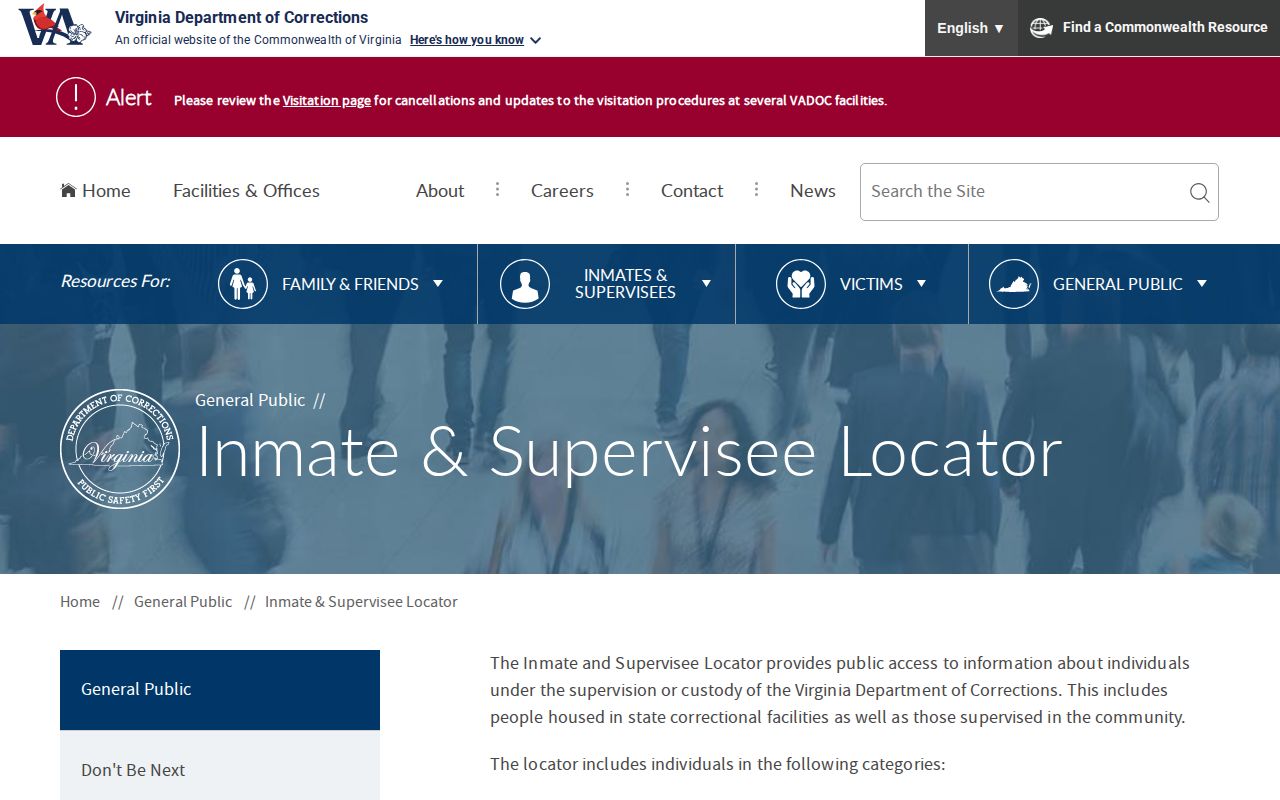
The locator can supply the current public date and location, but dated VADOC release paperwork remains stronger proof of actual release.
Virginia Credits Set Release Dates
VADOC time computation separates Good Conduct Allowance, or GCA, from Earned Sentence Credits, or ESC. GCA is the older framework for felony offenses committed before January 1, 1995 and misdemeanor offenses committed before July 1, 2008. For qualifying active or combined parole-eligible GCA sentences over 12 months, VADOC computes parole eligibility, mandatory-parole release, and good-time release dates. Classification can range from zero to 30 days of credit for each 30 days served. Virginia Code §§53.1-198 and 53.1-202 govern this older route.
ESC generally applies to felony offenses committed on or after January 1, 1995. Under §53.1-202.2, actual confinement and qualifying detention before trial enter the computation, and one credit deducts one day. Section 53.1-202.3 gives listed subsection-A offenses a maximum of 4.5 days per 30 served. Other eligible offenses may fall into levels of 15, 7.5, 3.5, or zero days per 30. The maximum is not guaranteed.
Classification, behavior, program-based statutory criteria, disciplinary forfeiture, sentence structure, and other events can change the rate. Section 53.1-202.4 governs forfeiture and administration. Earned credits also do not reduce the period that must pass before parole eligibility. A credit date and a parole date therefore answer different questions.
The official VADOC computation page shown below summarizes the GCA and ESC frameworks.
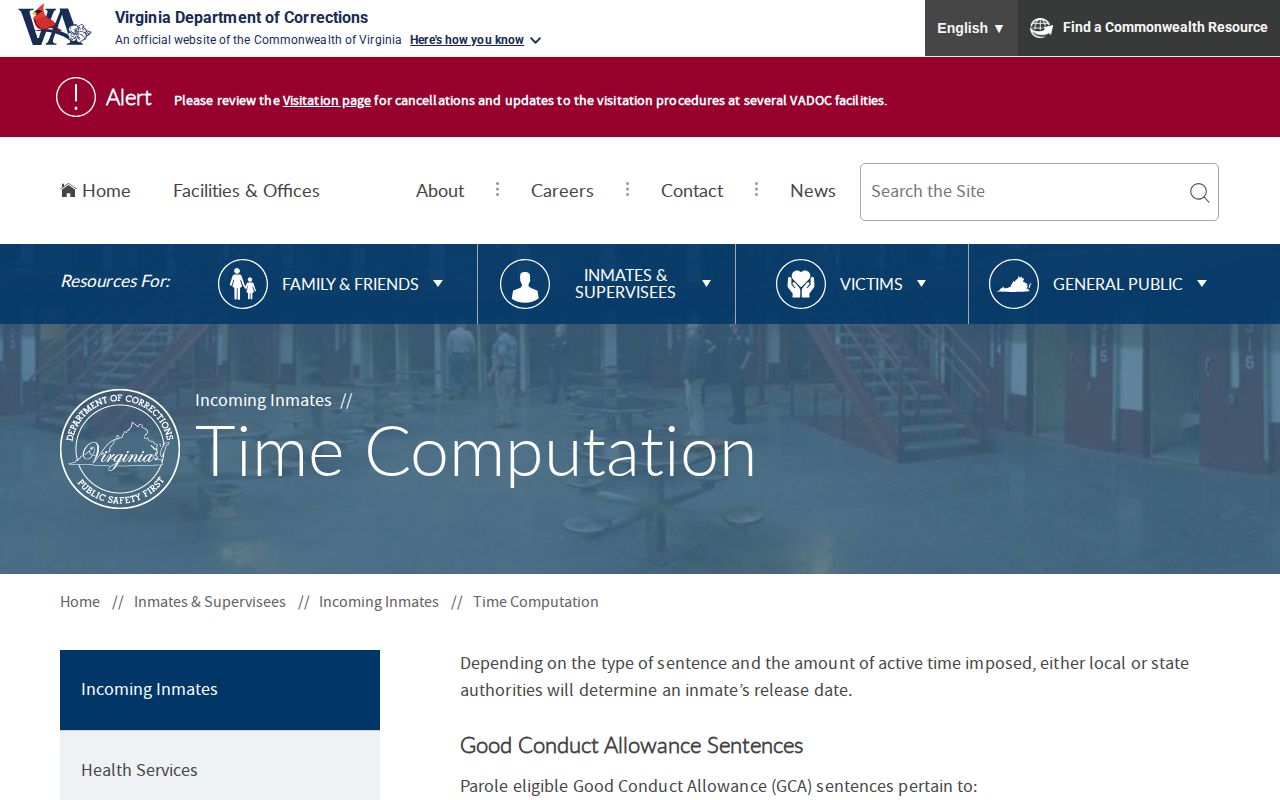
The two systems depend on offense and sentence dates, so one simple percentage cannot safely replace the official computation.
Sussex Release Date 85% Caveat
Virginia's familiar “serve 85 percent” shorthand comes from the older 4.5-day maximum credit for each 30 days served after discretionary parole was broadly abolished. That arithmetic can describe a consistently maximum-credit sentence in the traditional regime. It is not a universal rule. Enhanced ESC rates for qualifying non-enumerated offenses, the offense date, exclusions, current class, forfeitures, parole exceptions, consecutive terms, and other holds can all change the result.
Never calculate a Sussex County release date by multiplying the sentence by 85 percent alone. Begin with the offense date and the applicable credit statute. Then account for pretrial jail credit, total active sentence, class level, discipline, and any concurrent or consecutive structure. VADOC lists jail credit, sentence type, total sentence, class level, disciplinary offenses, and other events among its inputs. The official date is the agency's current computation, not a private estimate.
Why Sussex Release Dates Change
A future date can move for lawful reasons after it first appears. Some changes affect sentence credit. Others alter the sentence or prevent community release when the current term ends. The displayed date should always be paired with the search date and the person's current location.
| Factor | Possible effect | Best confirmation |
|---|---|---|
| Jail credit | Qualifying pretrial time can reduce active time still owed. | VADOC computation or local releasable computation record |
| Credit classification | A higher or lower ESC or GCA rate changes earned time. | Current agency calculation |
| Disciplinary forfeiture | Lost credit can move the date later. | VADOC record under the governing rules |
| Court order | An amended, concurrent, consecutive, or corrected sentence changes the base. | Signed order and updated computation |
| Parole decision | An eligible grant creates a release path after notice and planning. | Board report, locator, and actual release papers |
| Detainer or warrant | The person may leave one custodian but enter another. | Sending and receiving authority records |
A Parole Board grant does not mean immediate exit. Current §53.1-136 requires a post-grant notice and processing interval before VADOC sets the date, subject to the statute's exception. Likewise, sentence completion under one case does not clear a separate hold. Ask whether the destination was the community, supervision, or another custodian.
Note: Transfer ends custody at one site but is not an actual release from all legal custody.
Sussex County Jail Credit Policy
County computation is not the same as VADOC's state-prison calculation. Virginia Code §53.1-116 requires the jailer to maintain a written earned-credit policy and records for each committed person. No Sussex-specific policy was published online. The correct route is to ask the Sheriff or actual custodian for the policy and the person's releasable computation record rather than applying VADOC's tables to a local term.
Start with the full legal name, approximate booking date, case number, and booking number if known. Ask for the release date and time, release type, authority ordering release, destination, and the computation record if maintained and releasable. If the Sheriff identifies another physical custodian, direct the follow-up there. The county's public pages do not establish that every Sussex arrest remains in a building called Sussex County Jail, and Riverside Regional Jail is not an official routine Sussex substitute.
A pretrial bond order still does not create a fixed release time. Payment or surety, identity checks, booking tasks, and other warrants can delay or prevent exit. A time-served sentence may also lead straight to another hold. Search both the Sussex Combined Court and Circuit Court when a felony moved from preliminary proceedings to final judgment, then pair the correct order with the custodian's release entry.
Confirm Sussex County Actual Release
VADOC's facility process provides the strongest state-prison endpoint. On release day, the person reviews applicable Orders of Release and probation or parole conditions, then signs and dates the documents with a witness. VADOC supplies a Notification of Release letter. Those records distinguish discharge, parole, probation, and transfer more clearly than a future locator date.
For a local term, obtain the booking/release register entry from the actual jailer. For state custody, compare the locator with signed release papers and any supervision district. A pending event alert can help narrow timing, and the Sussex County VINE inmate check explains the separate local Jail VINE and state NAAVI systems. An alert is not enough by itself because local “release” wording may still mark a transfer.
Keep each milestone separate: the court sets or changes the sentence, the agency computes a future date, the custodian processes physical release, and a district may supervise the person afterward. That chain answers both when release was expected and whether it actually occurred.